

What is heat costing you?


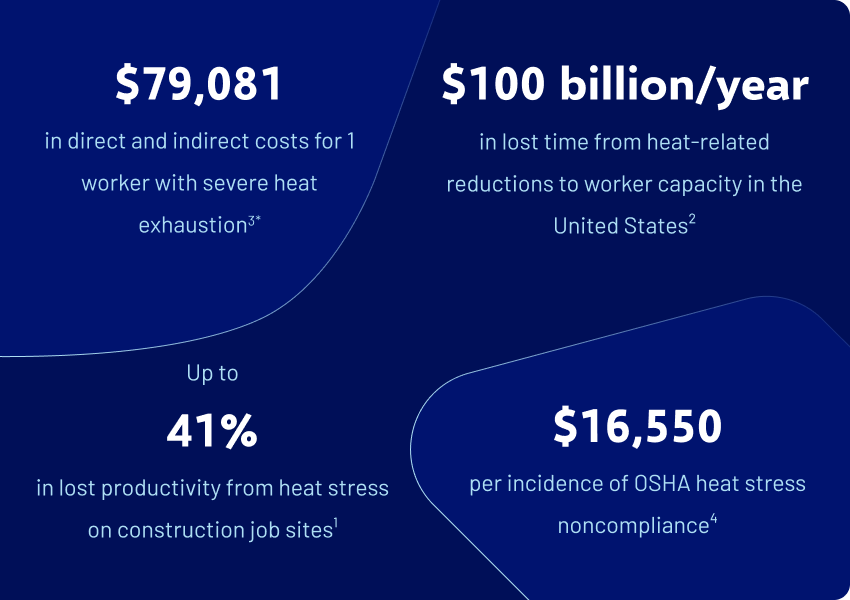

The Costs of Heat Stress Add Up
Investing in Heat Stress Prevention: From Risk to Return
The Hidden Costs of Heat
Based on a comprehensive model of heat’s impact across 14 categories, the average heat-related cost per employee is $40,000 to $80,000.
These costs include loss in productivity due to high-heat conditions, insurance increases, turnover and rehiring costs, OSHA noncompliance fines, and more.
Additionally, single, preventable, heat-related incidents can compound the financial strain of heat-related operational losses. On average, the per-incident cost of workers’ comp, direct medical, OSHA violation, and litigation/settlement pools is $200,000.

What Can SafeGuard Save Your Company?
When heat becomes a risk, SafeGuard gives your team a real-time edge. These examples show how fast the platform can deliver ROI for any size operation.
Small Roofing Company
Valiant Paving and Roofing is a highly respected commercial roofing and paving company. Their 15-person crew regularly works in high-heat environments where regulating core body temperature is a challenge. Last year alone, Valiant saw six workers leave. A few months later, new reviews on Glassdoor cited gaps in safety solutions as a key concern at Valiant.
Upon implementing SafeGuard, Valiant stood to save $68,000 in heat-related incident costs through real-time tracking.
The impact of SafeGuard was felt beyond the hard financials. The system helped prevent 1 worker hospitalization the following year, and resulted in 25% less turnover due to increased employee satisfaction and company morale.
$45,000
Includes the following estimated costs:
- Ambulance transport: $1,200–$2,500
- ER evaluation and treatment: $8,000–$15,000
- Hospital observation (1–2 days): $15,000–$25,000
Direct Costs from Medical
$3,000
Assumptions:
- 15-worker crew
- 20 workdays per season affected by extreme heat
- Average fully loaded labor cost (conservative estimate): $35/hour
Recovered productivity assumes a conservative 3.5% improvement during extreme-heat days.
- Daily labor cost: 15 crew members × $35/hour payrate × 8 hours in workday = $4,200/day
- $4,200 × 20 extreme-heat workdays = $84,000
- $84,000 × 3.5% in recovered productivity through SafeGuard = $2,940, rounded to $3,000
Productivity Costs
$20,000
Turnover costs include recruiting, onboarding, and lost ramp-up time. Research shows that workers who perceive their employer prioritizes safety report higher engagement and satisfaction, and Glassdoor data indicate that satisfied employees are less likely to apply for other jobs. Our model conservatively assumes SafeGuard helps retain one additional worker per year by improving safety culture and reducing fatigue.
Assumptions:
- Workforce: 15
- Conservative annual turnover tied to safety and working conditions: ~1 worker
- Replacement cost per skilled construction worker: $20,000 including recruiting, onboarding, training, lost productivity, and supervisor time
Turnover Costs
Midsize General Contractor
Zenith Construction Group is a mid-size General Contractor with 350 field employees operating across multiple sites, from steel framing in Texas to roofing in Florida. Their safety record is strong, but like all contractors, they struggle with peak summer productivity.
By purchasing SafeGuard for their workforce of 350 crew members, companies like Zenith Construction could save over $1 million annually in heat-related incident costs.
SafeGuard more than paid for itself in the 83 minor alerts issued to workers, helping prevent heat stress — and resulting injuries — from happening in the first place.
$135,000
Savings assume the following research-backed inputs:
- 3 heat-related hospitalizations prevented
- Average cost per heat hospitalization: $45,000, representing a severe heat illness requiring ER care, possible ICU observation, diagnostics, and short inpatient stay, but not a fatality or long-term disability claim.
- 3 hospitalizations × $45,000 = $135,000
Direct Costs from Medical
$750,000
Assumptions:
- Workforce of 350 field employees
- 60 workdays per year affected by extreme heat
- Peak heat impact: ~1 hour/day of lost productive output
- Average fully burdened labor cost (conservative estimate): $60/hour
Recovered productivity assumes a conservative 60% of realistically recoverable exposure through monitoring, pacing, early alerts, and supervisor intervention:
- Daily labor cost: 350 field employees × $60/hour pay rate × 1 hour/day = $21,000/day
- $21,000 × 60 extreme-heat workdays = $1,260,000 gross exposure
- $1,260,000 × 60% in recovered productivity through SafeGuard = $756,000, rounded to $750,000
Productivity Costs
$150,000
Turnover costs include recruiting, onboarding, and lost ramp-up time. Research shows that workers who perceive their employer prioritizes safety report higher engagement and satisfaction, and Glassdoor data indicate that satisfied employees are less likely to apply for other jobs. Our model conservatively assumes SafeGuard helps retain one additional worker per year by improving safety culture and reducing fatigue.
Assumptions:
- Workforce: 350
- Conservative annual turnover tied to safety and working conditions: ~2 workers
- Replacement cost per skilled construction worker: $75,000 including recruiting, onboarding, training, lost productivity, and supervisor time
- 2 workers × $75,000 = $150,000
Turnover Costs
83
minor alerts sent and managed
3
hospitalizations prevented
2
We based our analysis of schedule creep based on the following assumptions:
- 10% average heat-related productivity drag across the peak summer period (a conservative estimate)
- 30% in recovered productivity drag through SafeGuard-enabled interventions (alerts, pacing, breaks, hydration prompts, and reassignments)
- 10% × 30% = 3% of total peak-heat labor capacity
How we calculated our schedule creep estimate:
- Recovered hours: 168,000 (hours of full workforce) × 3% = 5,040 hours
- Scheduled days avoided (crew equivalent):
- Daily capacity of the full workforce = 350 × 8 = 2,800 hours/day
- Schedule creep avoided = 5,040 ÷ 2,800 = 1.8 days
days of schedule creep avoided during peak heat months
Enterprise Energy Company
Star Energy Corp. is a Fortune 500 company with 5,000 field employees working in high-hazard environments, including power plant maintenance, pipeline construction, and utility line repair across diverse climates.
Companies like Star can implement SafeGuard company-wide to centralize heat stress management through real-time monitoring and data-driven compliance. In this case, SafeGuard was deployed to help the organization’s safety teams effectively support the health and wellness of individual utility line workers.
By investing $250,000 annually in the SafeGuard platform, a company with 5,000 employees could generate an annual net profit of up to $1.6 million.
$340,000
Savings assume the following research-backed inputs:
- 1 severe heat illness (heat stroke or exertional collapse requiring ICU): $180,000
- Includes emergency response, ICU, and in-patient care, extended wage replacement, claims administration, and reserve
- 4 moderate heat events: $40,000 per incident × 4 events = $160,000
- Includes ER visit, treatment, and short recovery time
Direct Costs from Medical
$1.2M
Assumptions:
- Workforce of 5,000 field employees
- 10 workdays per year affected by extreme heat
- Average fully burdened labor cost (conservative estimate): $60/hour
Recovered productivity assumes a conservative 5% of productivity loss from heat-related drag (far below the 29–41% loss cited in several heat-related studies):
- Daily labor cost: 5,000 field employees × $60/hour pay rate × 8 hours/day = $2,400,000/day
- $2,400,000/day × 5% in recovered productivity through SafeGuard = $120,000
- $120,000 × 10 high-impact days = $1,200,000
Productivity Costs
$300,000
Turnover costs include recruiting, onboarding, and lost ramp-up time. Research shows that workers who perceive their employer prioritizes safety report higher engagement and satisfaction, and Glassdoor data indicate that satisfied employees are less likely to apply for other jobs. Our model conservatively assumes SafeGuard helps retain one additional worker per year by improving safety culture and reducing fatigue.
Assumptions:
- Workforce: 5,000
- Conservative annual turnover, assuming heat stress contributes to 0.2% incremental attritions: 10 workers
- Replacement cost per skilled construction worker: $30,000 including recruiting, onboarding, training, and lost ramp-up productivity
- 10 workers × $30,000 = $300,000
Turnover Costs
What You Don’t Know Can Cost You
As annual average temperatures continue to rise, the impact of heat on your workforce can’t be overstated. Learn how stress impacts worker physiology and performance.
Request a Custom Estimate
Stop reacting to heat risk. Request your custom estimate to discover how SafeGuard prevents heat-related incidents and generates a recurring profit center for your business.
DISCLAIMERS AND REFERENCES
*Many worker injuries are indirectly caused by heat stress.
References
- https://hsph.harvard.edu/environmental-health/news/heat-stress-impacts-workers-and-the-bottom-line/
- https://www.citizen.org/article/heat-stress-the-cost-of-inaction/
- https://www.osha.gov/safetypays/estimator
- https://www.osha.gov/penalties
- https://pmc.ncbi.nlm.nih.gov/articles/PMC12498468/
- https://injuryfacts.nsc.org/work/costs/workers-compensation-costs/
- https://www.beckerinjurylaw.com/settlements